
It’s Not About Proving a Crime
One of the biggest misunderstandings about Suspicious Matter Reports (SMRs) is that businesses believe they need proof that a customer has committed a crime before making a report.
That isn’t the purpose of an SMR.
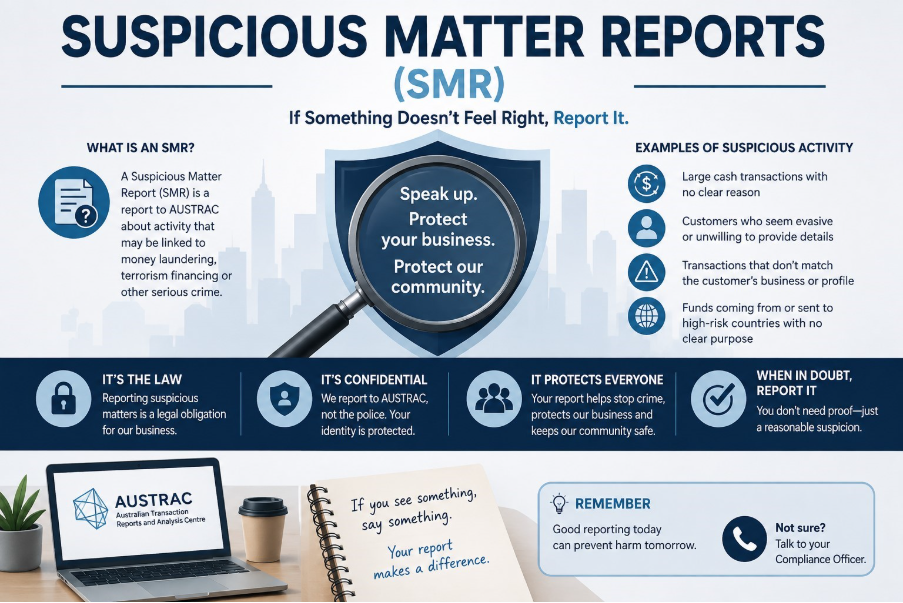
The Anti-Money Laundering and Counter-Terrorism Financing (AML/CTF) legislation requires reporting entities to notify AUSTRAC whenever they have reasonable grounds to suspect that a transaction, attempted transaction, or customer activity may be connected to criminal activity, money laundering, terrorism financing, tax evasion, fraud or other serious offences.
The key word is suspect.
You are not expected to investigate crimes or gather evidence to the standard required by a court. Your responsibility is to recognise unusual behaviour, assess whether it raises reasonable suspicion, and report it to AUSTRAC.
Why Does AUSTRAC Need Suspicious Matter Reports?
Every reporting entity only sees a very small part of a customer’s activity.
A registered club may only see gaming transactions.
A real estate agency may only see a property purchase.
A bullion dealer may only see precious metal purchases.
An accountant may only see financial records.
On their own, these activities may appear perfectly legitimate.
AUSTRAC, however, receives information from thousands of reporting entities across Australia every day. By combining Suspicious Matter Reports with Threshold Transaction Reports, International Funds Transfer Instructions and other intelligence, AUSTRAC can identify patterns that no individual business could ever detect.
A transaction that appears insignificant in one business may become highly suspicious when linked to activity reported by several other organisations.
This intelligence-led approach allows AUSTRAC to identify:
- Money laundering networks
- Organised crime groups
- Drug trafficking operations
- Tax evasion schemes
- Fraud
- Terrorism financing
- Child exploitation offences
- Other serious criminal activities
Without Suspicious Matter Reports, many of these criminal networks would remain hidden.
Your Role Is to Report Suspicion
Reporting entities are often concerned about whether they have “enough evidence.”
The legislation does not require certainty.
Instead, staff should ask themselves:
“Do I have reasonable grounds to suspect that something isn’t right?”
“Is this behaviour out of the norm for this type of customer?”
If the answer is yes, the matter should be escalated internally and considered for reporting.
Your AML/CTF Program should clearly explain:
- What behaviours may indicate suspicious activity.
- Who staff report concerns to.
- How investigations are documented.
- Who decides whether an SMR should be submitted.
- How records are retained.
Having a documented process helps ensure decisions are consistent and can be justified if reviewed by AUSTRAC.
What Might Create Suspicion?
Every industry has different money laundering risks, but common indicators include:
- A customer attempting to avoid identification requirements.
- Transactions that do not match the customer’s known circumstances.
- Unusual cash activity.
- Customers providing inconsistent or false information.
- Reluctance to explain the source of funds.
- Transactions structured to avoid reporting thresholds.
- Multiple people appearing to act on behalf of another person.
- Behaviour that simply doesn’t make commercial or practical sense.
One indicator on its own may not be suspicious.
Several indicators occurring together often justify further consideration.
Why Timing Matters
Once a reporting entity forms a reasonable suspicion, there are strict legislative timeframes for lodging a Suspicious Matter Report.
Prompt reporting allows AUSTRAC and law enforcement agencies to respond quickly where criminal activity may be occurring.
Delays can reduce the value of the intelligence and may result in non-compliance with AML/CTF obligations.
Businesses should ensure staff understand when concerns need to be escalated so decisions can be made.
SMRs must be submitted to AUSTRAC within:
- 24 hours of forming the suspicion if related to terrorism financing
- 3 business days after the day you formed the suspicion for other suspicions.
For detailed guidance on Suspicious Matter Reports, including reporting requirements and submission processes, refer to AUSTRAC’s guidance on Suspicious Matter Reports.
A Strong Compliance Culture Is Essential
The best organisations create a culture where staff feel comfortable raising concerns.
Employees should never worry about “getting it wrong” when reporting internally.
Most internal reports will not become Suspicious Matter Reports – and that’s perfectly acceptable.
It is far better for staff to raise concerns than to ignore behaviour that could later prove significant.
Training, regular transaction monitoring, documented procedures and effective supervision all contribute to better identification of suspicious matters.
Final Thoughts
Suspicious Matter Reports are one of Australia’s most valuable tools in the fight against financial crime.
Every report contributes to a much larger intelligence picture that helps protect Australia’s financial system and disrupt organised crime.
As a reporting entity, your responsibility is not to prove criminal activity.
Your responsibility is to identify unusual behaviour, assess whether reasonable grounds for suspicion exist, and report those concerns through the appropriate process.
A single Suspicious Matter Report may appear minor in isolation – but when combined with thousands of others, it could be the missing piece that enables AUSTRAC to uncover a major criminal network.
For that reason, every reporting entity has an important role to play in protecting both their business and Australia’s financial system.
If you’re unsure whether your AML/CTF Program adequately addresses Suspicious Matter Reports or need assistance developing compliant reporting procedures, contact CHD Partners. Our experienced compliance consultants can help you strengthen your AML/CTF framework and meet your reporting obligations with confidence.