
Working at height is a common workplace activity across registered clubs, hospitality venues, retail stores, warehouses and manufacturing businesses. However, using ladders to access elevated storage areas or complete routine maintenance can expose workers to unnecessary fall risks.
A Work Assist Vehicle offers a practical alternative to traditional ladders for suitable tasks. Designed to elevate workers on a purpose-built platform, this equipment can help businesses improve workplace safety, reduce exposure to ladder-related hazards and make everyday tasks more efficient.
For businesses reviewing their work health and safety (WHS) procedures, understanding the benefits of a Work Assist Vehicle is an important step towards improving fall prevention and managing working at height risks.
Whether workers are retrieving decorations from a storeroom, accessing stock on high shelves, replacing signage or undertaking routine facility maintenance, choosing the right access equipment can make a significant difference.
What Is a Work Assist Vehicle and How Does It Improve Working at Height Safety?
A Work Assist Vehicle (WAV), sometimes referred to as a Wave, is a compact, powered mobile platform designed to elevate a worker so they can safely access items and undertake suitable tasks above floor level.
Unlike a conventional ladder, a Work Assist Vehicle provides a purpose-designed standing platform, with safety barriers and operational controls intended to reduce the likelihood of a fall.
Some models also have integrated load trays, allowing workers to retrieve and transport suitable items without carrying them while climbing.
For example, the Crown Wave WAV 60 can lift an operator to a platform height of approximately three metres, providing a working reach of up to five metres, depending on the operator and task.
The equipment is designed for use in environments such as warehouses, retail stores, hospitality facilities and storage areas.
A Work Assist Vehicle is particularly useful for businesses that regularly require employees to access elevated areas. By providing a stable working platform, this equipment can help reduce reliance on traditional ladders for suitable workplace activities.
While individual models differ, a suitable WAV can effectively manage work that would otherwise involve frequent ladder use.
Five Benefits of Using a Work Assist Vehicle for Workplace Safety
1. Reducing Workplace Fall Risks
One of the greatest benefits of a Work Assist Vehicle is its potential to reduce exposure to ladder-related hazards.
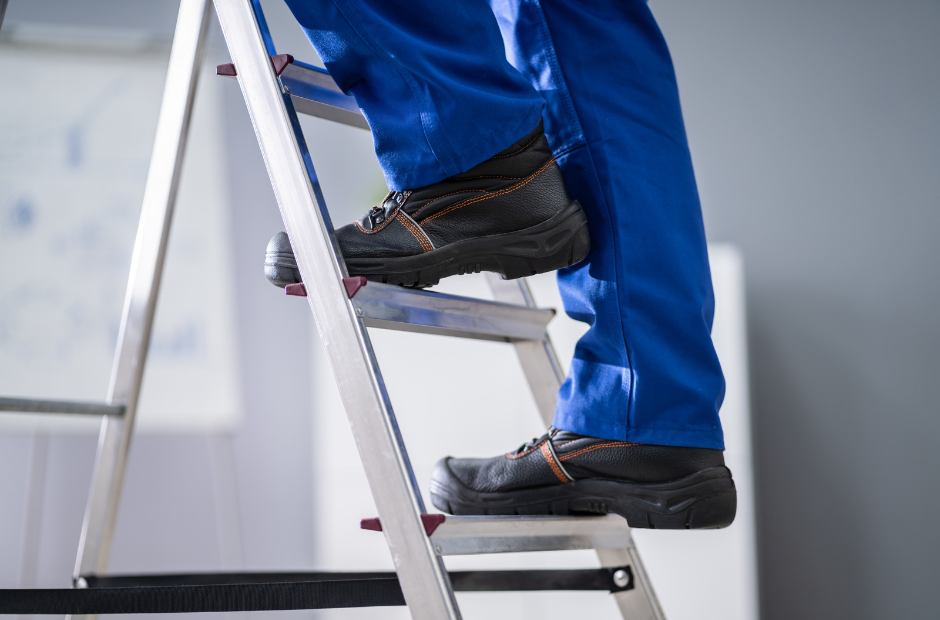
Workers using ladders may be exposed to risks from:
- Overreaching to access items.
- Losing balance while handling objects.
- Carrying materials while climbing.
- Incorrect ladder positioning.
- Slipping while ascending or descending.
- Standing on unsuitable steps or using a ladder beyond its intended purpose.
A suitably selected Work Assist Vehicle addresses several of these risks by providing a guarded working platform that can be elevated to the appropriate working height.
Some models also incorporate interlocked gates, operator-position sensors and automatic operating restrictions.
These features help manage the risk of falls, although they do not eliminate it entirely.
Choosing suitable height safety equipment is an important consideration for businesses looking to strengthen their workplace risk management practices.
The key question is whether the equipment provides a safer way to complete the task, rather than simply continuing to use a ladder because one is available.
2. Improving Ladder Safety When Retrieving Items at Height
Retrieving items from elevated storage areas is a common activity that often receives limited attention during workplace risk assessments.
Consider a registered club storeroom containing Christmas decorations, marketing materials, spare supplies, glasses or event equipment.
Staff may regularly use stepladders to retrieve these items.
The risk increases when workers attempt to carry objects down a ladder, particularly if the item is awkward, heavy or difficult to hold.
A Work Assist Vehicle equipped with a suitable load tray can help reduce these risks.
Workers can position the platform at an appropriate height, retrieve items within the equipment’s rated capacity and use its designed load-handling features to bring materials down.
This reduces the need to carry items while climbing and can help minimise manual handling risks.
However, items must be suitable for the equipment, remain within rated load limits and be handled without overreaching or compromising the platform’s stability.
Businesses should also consider whether frequently accessed items can be moved to lower shelves to reduce the need for working at height altogether.
3. Improving Workplace Productivity
Workplace safety improvements can also create operational benefits.
Traditional ladder use may involve repeatedly positioning, climbing, descending and relocating a ladder.
When workers are retrieving multiple items across a storeroom or warehouse, this can become time-consuming.
A suitable Work Assist Vehicle allows workers to reposition the equipment between tasks and adjust the platform height using powered controls.
This can make stock retrieval, shelving and routine access tasks more efficient.
In environments where workers frequently access elevated storage, time savings can be significant.
For business owners and club managers, this creates an opportunity to improve productivity while reducing exposure to a known workplace hazard.
Investing in appropriate workplace safety equipment can also support more consistent work practices across different departments and operational areas.
4. Supporting Safer Maintenance Activities
Registered clubs and other businesses have ongoing maintenance requirements.
These may include:
- Inspecting suitable overhead fixtures.
- Accessing high-level signage.
- Undertaking authorised light maintenance.
- Checking elevated shelving and fittings.
- Accessing equipment located above normal standing height.
A Work Assist Vehicle may provide a safer access method for selected tasks where the equipment suits the work environment.
However, not all maintenance activities are suitable for a WAV.
Tasks involving electrical hazards, substantial physical force, restricted overhead clearance, heavy equipment or access beyond the equipment’s limits may require specialist contractors and other types of work platforms.
Businesses should assess maintenance activities before work begins, including whether the worker has the necessary trade qualifications, training and authorisation.
Selecting appropriate equipment and implementing suitable workplace risk controls are essential parts of effective WHS management.
5. Demonstrating a Proactive Approach to WHS Compliance
Investing in safer equipment can also demonstrate an organisation’s commitment to managing workplace risks.
Under NSW work health and safety legislation, businesses must eliminate risks to health and safety so far as is reasonably practicable. Where elimination is not reasonably practicable, they must minimise the risks using appropriate controls.
A fundamental principle of managing falls is to first consider whether the work can be undertaken from the ground or a solid construction.
If this is not reasonably practicable, suitable fall prevention devices and other controls must be considered.
A properly selected Work Assist Vehicle can be one practical option.
Importantly, purchasing equipment alone does not demonstrate WHS compliance.
Businesses must also establish safe operating procedures, provide appropriate training, inspect and maintain the equipment and ensure workers use it correctly.
A proactive approach to workplace safety involves identifying potential hazards, assessing risks and selecting controls that are appropriate for the work being performed.
What Do the 2026 NSW WHS Changes Mean for Working at Height?
From 1 July 2026, section 26A of the Work Health and Safety Act 2011 (NSW) introduced a specific duty relating to compliance with approved Codes of Practice.
Businesses must comply with applicable Codes of Practice or manage the relevant hazards and risks using methods that achieve an equivalent or higher standard of work health and safety.
The Managing the Risk of Falls at Workplaces Code of Practice provides guidance on controlling falls, including using suitable working platforms.
The Elevating Work Platforms Code of Practice, which commenced in NSW on 10 July 2026, provides further guidance relevant to mobile elevating work platforms.
For business owners, these requirements reinforce the importance of reviewing existing work practices and understanding applicable workplace safety obligations.
If workers regularly use ladders to access elevated storage or undertake maintenance, management should consider whether a safer alternative is reasonably practicable.
A Work Assist Vehicle may be one option worth evaluating as part of a broader fall prevention strategy.
The question should not simply be whether staff know how to use a ladder. It should be whether the ladder is the most appropriate equipment for the work.
What Should Businesses Consider Before Using a Work Assist Vehicle?
Although a Work Assist Vehicle offers potential safety and productivity benefits, it is still powered mobile plant and introduces risks that must be managed.
Before purchasing, hiring or operating this equipment, businesses should consider the following factors.
Equipment suitability: Is the equipment designed for the task, and can it safely reach the required height?
Floor conditions: Are the operating surfaces sufficiently level, stable and capable of supporting the equipment and its loads?
Pedestrian movement: Can staff, members, customers and visitors be kept clear of the operating area?
Load capacity: Are the worker, tools and materials within the manufacturer’s rated capacities?
Operator competency: Have operators received appropriate equipment-specific training, familiarisation and Verification of Competency (VOC)?
Maintenance and inspections: Are pre-use checks, servicing and periodic inspections undertaken and recorded?
Emergency arrangements: Are procedures established for safely lowering or assisting an operator if the equipment fails while elevated?
Other hazards: Have overhead obstructions, falling objects, crush points and nearby electrical services been assessed?
For example, the manufacturer advises that the Crown Wave model does not require a national high-risk work licence to operate. However, operators must still be appropriately trained and competent. Licensing requirements for other plant must be checked according to the equipment’s classification and relevant legislation.
Businesses should also follow the manufacturer’s instructions and confirm whether any additional fall protection is required for their equipment and operating conditions.
You can find further information about the equipment through Crown Equipment Australia’s Work Assist Vehicle specifications.
A Practical Example: Improving Working at Height Safety in Registered Clubs
Consider a registered club that stores seasonal decorations, marketing materials and spare equipment on shelving approximately four metres above floor level.
Throughout the year, maintenance and operational staff use stepladders to retrieve items.
A workplace risk assessment identifies several concerns, including workers overreaching, handling awkward objects while descending ladders and moving ladders through shared work areas.
The club evaluates whether a Work Assist Vehicle would provide a safer solution.
Following a risk assessment, management identifies a suitable model, confirms floor and storage-area compatibility and establishes a designated operating procedure.
Relevant staff receive training, the club introduces pre-use inspections and the equipment is incorporated into its plant maintenance arrangements.
The club also reviews storage practices, moving frequently used and heavier items to lower shelving where reasonably practicable.
The result is a more considered approach to managing elevated storage.
Rather than relying entirely on worker behaviour and ladder safety instructions, the club has introduced additional physical risk controls and improved the way work is organised.
This example demonstrates how reviewing everyday workplace activities can help organisations identify opportunities to improve fall prevention and strengthen their overall WHS arrangements.
Is a Work Assist Vehicle Worth the Investment?
For smaller businesses, the cost of purchasing specialised equipment is an important consideration.
However, businesses should look beyond the initial purchase price.
They should consider how often workers access elevated areas, whether safer access methods are readily available, and whether hiring, sharing or purchasing equipment would be appropriate.
Potential benefits of a Work Assist Vehicle include:
- Reduced exposure to ladder-related fall hazards.
- Improved handling of suitable items at height.
- Greater efficiency in repetitive stock retrieval.
- Less time spent repositioning ladders.
- Improved access for appropriate maintenance activities.
- A more consistent and controlled approach to working at height.
- Better integration of physical safety controls into everyday operations.
A Work Assist Vehicle will not be the right solution for every workplace.
In some circumstances, adjustable shelving, ground-level storage, a mobile platform ladder or another type of elevating work platform may provide a more suitable control.
The decision should follow a risk assessment, consultation with workers and consideration of reasonably practicable alternatives.
For businesses that regularly undertake elevated storage and retrieval activities, evaluating the suitability of this equipment may be a worthwhile part of their workplace safety improvement strategy.
Our Message to Business Owners and Club Managers
Managing workplace safety is not just about telling workers to be careful. It is about providing them with safer ways to complete their work.
At CHD Partners, we encourage registered clubs and small to medium businesses to review everyday activities that may have become accepted simply because they have always been done that way.
Retrieving items from high shelves and undertaking routine maintenance are good examples.
A ladder may have been the traditional solution, but it does not always mean it is the most appropriate one.
A Work Assist Vehicle demonstrates how selecting suitable equipment can help reduce workplace risks while improving operational efficiency.
For businesses reviewing their falls management arrangements, the priority should be straightforward:
- Identify the task.
- Assess the risk.
- Consider safer alternatives.
- Train your people.
- Maintain the equipment.
- Keep evidence of what you have done.
These steps can help businesses develop more effective working at height procedures and strengthen their overall workplace safety practices.
How CHD Partners and CIRT Can Help
CHD Partners supports registered clubs and small to medium businesses in understanding and implementing practical work health and safety requirements.
Through CIRT, organisations can maintain risk assessments, plant and equipment information, workplace inspection records, training evidence and maintenance activities.
We focus on making compliance practical and achievable, without creating unnecessary paperwork.
Good safety management isn’t just about having a procedure. It is about making sure safer work practices happen every day.
If your organisation needs assistance reviewing workplace safety procedures, risk assessments or WHS compliance requirements, contact CHD Partners to discuss how we can support your business in implementing practical and effective safety management processes.
References and Further Reading
1. SafeWork NSW – [Managing the Risk of Falls at Workplaces Code of Practice](https://www.safework.nsw.gov.au/__data/assets/pdf_file/0018/50076/Managing-the-risk-of-falls-at-workplaces-COP.pdf).
2. SafeWork NSW – [Elevating Work Platforms Code of Practice, July 2026](https://www.safework.nsw.gov.au/__data/assets/pdf_file/0009/1416474/Elevating_work_platforms-COP.pdf).
3. SafeWork NSW – [Codes of Practice and section 26A requirements](https://www.safework.nsw.gov.au/resource-library/codes-of-practice).
4. Crown Equipment Australia – [Wave Work Assist Vehicle, features and specifications](https://www.crown.com/en-au/forklifts/man-up-order-pickers/wav-wave-work-assist-vehicle.html).
5. Crown Equipment Australia – [Wave Operator Training](https://www.crown.com/en-au/safety-training/training/wave-operator-training.html).
#CHDPartners #CIRT #RTO #WHS #WorkHealthAndSafety #Training #RiskManagement #SecurityAndSafetyCompliance #SME #SmallBusiness #MichaelHuggett #WHSCompliance
