
TILE approach manual handling is one of the most effective methods for identifying hazardous manual task risks in Australian workplaces.
Hazardous manual tasks remain one of the leading causes of workplace injuries across Australia. Strains, sprains, back injuries and musculoskeletal disorders commonly occur across industries such as hospitality, construction, engineering, transport, electrical work and office administration.
The TILE approach manual handling method helps workers and employers assess risks before completing lifting, carrying, pushing, pulling or repetitive tasks. By evaluating the task, the worker, the load and the environment, businesses can reduce injury risks and improve workplace safety outcomes.
The TILE approach also supports compliance with guidance provided by Safe Work Australia and aligns with the Hazardous Manual Tasks Code of Practice.
What Is TILE Approach Manual Handling?
TILE stands for:
- T – Task
- I – Individual
- L – Load
- E – Environment
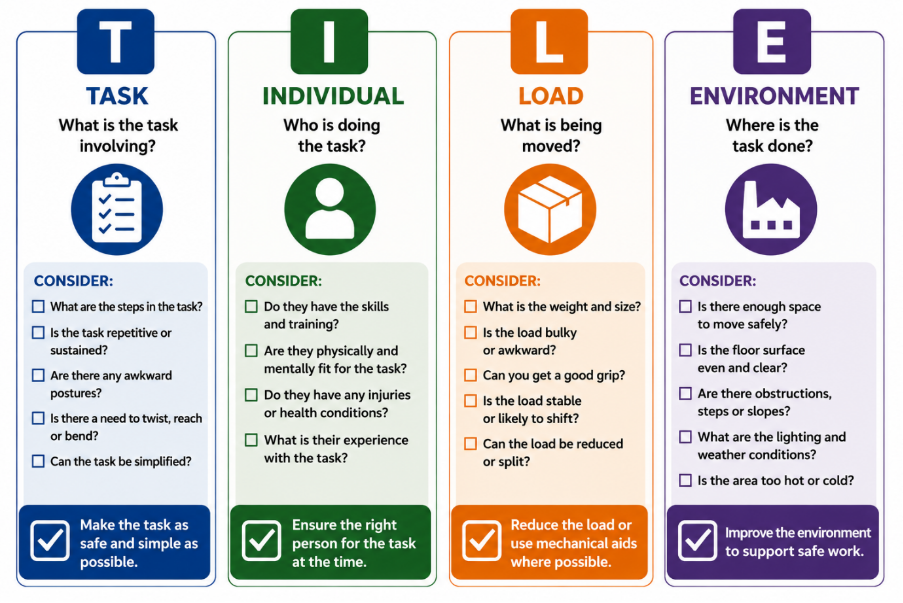
The TILE approach manual handling assessment is a practical risk assessment tool used to identify hazards associated with manual handling activities before injuries occur.
Rather than focusing only on how heavy an object is, the TILE approach encourages workers to assess the entire activity, including:
- What task is being completed
- Who is performing the task
- What is being handled
- Where the task is taking place
This broader assessment helps workers identify risks that may otherwise be overlooked.
T – Task
The first step in the TILE approach manual handling process is assessing the task itself.
Workers should consider:
- Is the task repetitive?
- Does it involve twisting, bending or reaching?
- Is the task performed for long periods?
- Does the task involve pushing, pulling or carrying?
- Is an awkward posture required?
- Does the task involve sudden movements?
- Does the worker need to lift above shoulder height or below knee height?
Example
A hospitality worker repeatedly carrying heavy trays during a busy shift may experience fatigue and muscle strain from repetitive movements and awkward carrying positions.
An electrician installing cables above ceiling height may be required to work with arms elevated for extended periods, increasing shoulder and neck strain.
I – Individual
This stage considers the person performing the manual handling task.
Factors may include:
- Physical capability
- Experience and training
- Age and fitness
- Existing injuries or medical conditions
- Fatigue levels
- Understanding of safe work procedures
Example
A new worker without proper manual handling training may attempt to lift heavy materials incorrectly.
A fatigued worker at the end of a long shift may have an increased risk of injury while lifting or carrying loads.
L – Load
The load refers to the object, equipment or materials being moved or handled.
Workers should consider:
- Is the load heavy?
- Is it difficult to grip?
- Is it unstable?
- Does it have sharp edges?
- Can contents move unexpectedly?
- Is the load awkward in shape or size?
- Does the load block visibility?
Example
An administration worker lifting archive boxes may struggle due to awkward dimensions and poor handholds.
A maintenance worker moving a long steel beam may have difficulty balancing the load safely.
E – Environment
The environment can significantly affect the safety of a manual handling task.
Environmental factors may include:
- Slippery or uneven floors
- Poor lighting
- Restricted spaces
- Weather conditions
- Noise distractions
- Poor housekeeping
- Temperature extremes
- Limited access or exits
Example
A kitchen worker carrying stock through a wet floor area faces an increased risk of slips and falls.
A warehouse worker operating in a cramped storage space may be forced into awkward lifting postures.
7 Powerful Benefits of TILE Approach Manual Handling
1. Helps Prevent Workplace Injuries
One of the biggest benefits of TILE approach manual handling is injury prevention.
By assessing manual tasks before work begins, businesses can identify hazards early and implement effective control measures before injuries occur.
This helps reduce:
- Back injuries
- Shoulder strains
- Sprains
- Muscle fatigue
- Soft tissue injuries
- Musculoskeletal disorders
2. Supports WHS Compliance
Australian employers have a duty under Work Health and Safety legislation to eliminate or minimise risks associated with hazardous manual tasks so far as is reasonably practicable.
Using the TILE approach manual handling assessment helps organisations demonstrate they are:
- Identifying hazards
- Assessing risks
- Implementing controls
- Providing worker guidance and training
This supports compliance with:
- Work Health and Safety Act
- Work Health and Safety Regulations
- Hazardous Manual Tasks Code of Practice
For additional guidance, businesses can refer to Safe Work Australia.
3. Encourages Workers to Think Before Acting
The TILE approach manual handling method promotes a proactive workplace safety culture.
Workers become more aware of:
- Unsafe work practices
- Environmental hazards
- Physical limitations
- Safer ways to complete tasks
This encourages workers to stop and assess risks instead of rushing into unsafe manual handling activities.
4. Improves Communication and Consultation
The TILE approach provides workers and supervisors with a simple and consistent language for discussing manual handling risks.
Instead of simply saying:
“Be careful lifting that.”
Workers can discuss:
- The difficulty of the task
- The shape and weight of the load
- Environmental hazards
- Whether assistance or equipment is required
This improves consultation, teamwork and workplace communication.
5. Encourages Better Control Measures
Once risks are identified using TILE approach manual handling assessments, businesses can implement more effective control measures such as:
- Mechanical lifting aids
- Trolleys or pallet jacks
- Team lifting procedures
- Job rotation
- Improved workplace layouts
- Reduced load sizes
- Better storage systems
- Additional training
The focus shifts from relying solely on “proper lifting techniques” to creating safer systems of work.
6. Easy to Learn and Apply
One of the biggest strengths of the TILE approach manual handling process is its simplicity.
Workers can quickly remember the four components and apply them during everyday work activities.
This makes TILE highly effective for:
- Toolbox talks
- Inductions
- Pre-start meetings
- Safety training sessions
- Young or inexperienced workers
7. Reduces Long-Term Injury Costs
Manual handling injuries can result in:
- Workers compensation claims
- Lost productivity
- Increased absenteeism
- Staff shortages
- Higher insurance costs
Implementing TILE approach manual handling assessments helps businesses reduce preventable injuries and minimise long-term operational costs.
Practical Example of TILE Approach Manual Handling in Action
Scenario
A worker in a hotel storeroom is required to move cartons of beverages from storage shelves onto a trolley.
TILE Assessment
Task
- Repetitive lifting during busy periods
- Twisting while loading cartons onto the trolley
Individual
- Worker is new and inexperienced
- Worker reports fatigue late in the shift
Load
- Cartons weigh 18kg
- Awkward to grip
- Stored above shoulder height
Environment
- Limited space between shelves
- Wet floor conditions near refrigeration units
Control Measures Implemented
- Lower shelf storage introduced
- Smaller load quantities used
- Anti-slip floor mats installed
- Manual handling training provided
- Two-person lifting procedures introduced
Result
Reduced strain injuries and safer workplace practices.
Conclusion
The TILE approach manual handling method is a simple but highly effective way to identify and manage hazardous manual handling risks in the workplace.
By assessing:
- The Task
- The Individual
- The Load
- The Environment
workers and businesses can make safer decisions before injuries occur.
For small and medium businesses, the TILE approach provides an easy-to-understand framework that improves workplace safety awareness, supports WHS compliance and helps reduce preventable musculoskeletal injuries.
When combined with proper training, consultation and practical control measures, TILE approach manual handling strategies can help build safer and healthier workplaces across Australia.
If your business is looking to improve workplace safety, reduce manual handling risks or strengthen WHS compliance, contact CHD Partners to learn more about our workplace safety training, compliance support and hazardous manual task management solutions.
