I was talking with a new client recently about setting up their WHS Management System.
They had a story that I suspect will sound familiar to many small business owners.
They had both worked in a similar business before. He was the tradie doing the work. She worked in the office keeping everything moving.
They knew the industry. They knew the customers. They knew how the work should be done.
And eventually they looked at each other and said:
“We can do this better.”
So, they left and started their own business.
As they were telling me their story, I couldn’t help but smile.
Because I thought: I’ve heard this story before.
It was mine.
How hard could it be?
Before starting my own business, I spent 16 years in the NSW Police.
At one stage I was an Education Development Officer responsible for the training and development of more than 400 staff in one command and later around 150 in another.
I knew how to train people.
I knew how to develop training materials.
I knew how to organise and schedule training.
I knew my job.
So, naturally, I thought: why not leave and start my own business?
Simple.
Except, as many business owners eventually discover, being very good at your profession doesn’t necessarily mean you know how to run a business.
Around that time, I read Michael Gerber’s The E-Myth Revisited. I even went to one of his workshops.
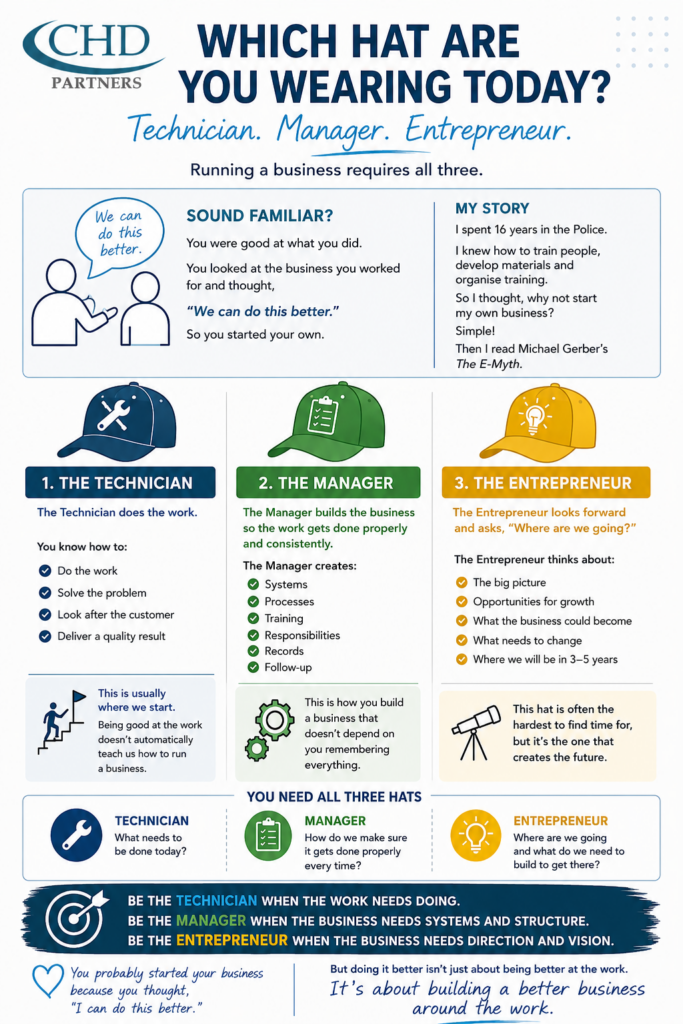
Gerber talks about three different roles we need to play in a small business:
The Technician.
The Manager.
The Entrepreneur.
The Technician does the work.
The Manager creates the systems, processes and structure that allow the work to happen consistently.
The Entrepreneur looks forward. They think about where the business is going, what it could become and what needs to change to get there.
I understood the Technician.
I could understand the Manager.
But if I’m being fair to the younger version of myself, I really had no idea what being an entrepreneur meant.
I just knew I was good at what I did and thought that would be enough.
The “entrepreneurial seizure”
Gerber describes something he calls the “entrepreneurial seizure.”
It’s that moment when a good Technician thinks:
“Why am I doing this for someone else? I could do this myself.”
And sometimes:
“I could do it better.”
That’s exactly what my new clients had experienced.
They were good Technicians.
They understood their industry.
They knew how to deliver the service.
But they had come from another business with very few systems and processes to learn from.
So when they started their own business, they knew how to do the work, but nobody had ever really shown them how to build the business around the work.
And that distinction is enormous.
Eventually, you need all three hats
This is where I think many small business owners get caught.
At the beginning, the Technician dominates.
You quote the job.
You do the job.
You answer the phone.
You fix the problem.
You send the invoice.
You chase the payment.
And because you’re good at what you do, the business starts growing.
Then suddenly you have employees.
There are vehicles and equipment to manage.
Customers need following up.
Someone gets injured.
A worker needs training.
There are HR issues.
WHS requirements appear.
Policies and procedures need developing.
Someone needs to check whether things are being done.
And somewhere amongst all of that, you’re supposed to find the time to think about where the business will be in three years.
That’s when the three hats really start to matter.
The Technician asks:
What work needs to be done today?
The Manager asks:
How can we make sure this gets done properly every time?
The Entrepreneur asks:
Where are we going, and what business do we need to build to get there?
None of those hats is more important than the others.
The problem comes when we forget to change hats.
WHS is a good example
Our conversation began when we discussed their WHS Management System.
But really, we were talking about something much bigger.
They didn’t want to recreate the business they had just left.
They wanted to build something better.
That means not waiting until there are 20 employees before implementing systems.
It means starting to document how things should be done.
Training people properly.
Setting expectations.
Creating simple processes.
Keeping records.
Learning how to delegate.
And gradually building a business that doesn’t rely entirely on the owners to remember everything and make every decision.
That’s the Manager hat.
Then occasionally you must stop doing and managing long enough to put on the Entrepreneur hat and ask:
“What are we actually trying to build?”
I still must remind myself
I’ve been in business for many years now, and I still find myself slipping back into the Technician role.
Sometimes it’s easier.
There’s satisfaction in doing something you’re good at.
Managing can be harder.
Leading can be harder again.
And sitting quietly thinking about where the business needs to go next can sometimes feel less productive than ticking another five things off the list.
But it’s necessary.
So perhaps the lesson isn’t that we need to stop being Technicians.
It’s remembering that being a business owner requires us to wear all three hats.
Be the Technician when the work needs to be done.
Be the Manager when the business needs systems, structure and consistency.
And make time to be the Entrepreneur who looks beyond today’s problems and decides where the business is going next.
If you started your business because one day you thought, “I can do this better,” you’re certainly not alone.
Just remember:
Doing it better isn’t only about being better at the work.
It’s about building a better business around the work.
#Leadership #Supervisors #Management #SmallBusiness #LeadershipDevelopment #BusinessOwners #CHDPartners #CIRT #MichaelHuggett #HumanResources