

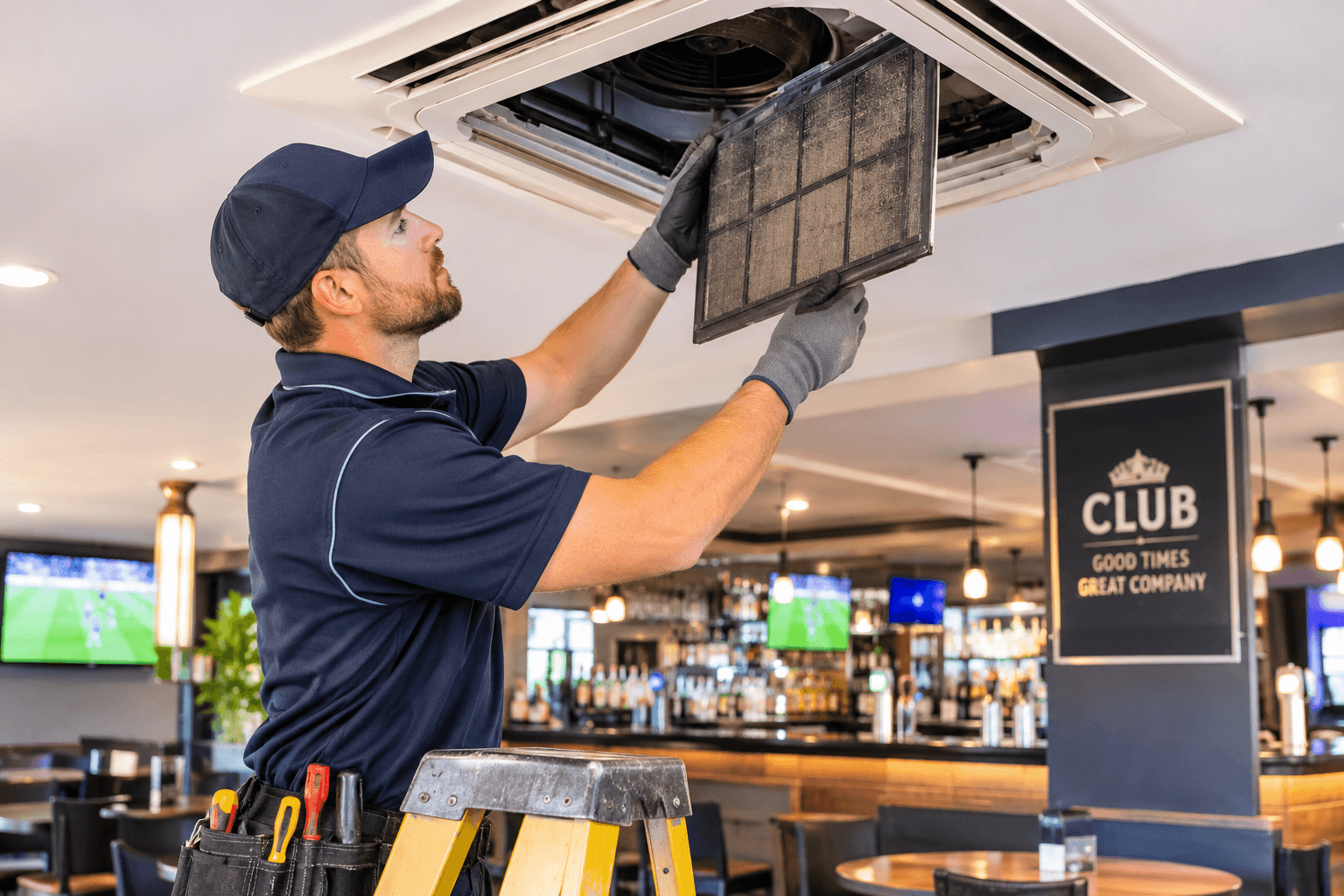
Contractor Management in Registered Clubs is an essential part of maintaining workplace health and safety (WHS) compliance. While engaging qualified contractors is important for maintenance and repairs, registered clubs remain responsible for managing workplace risks and ensuring that contractors, employees, members and visitors are protected from falls and other workplace hazards.
Every registered club relies on contractors to keep its facilities operating. Electricians replace lighting, plumbers repair leaking pipes, air-conditioning technicians service rooftop equipment, cleaners maintain floors, and roofing contractors repair gutters and roof sheeting.
Most of these jobs are routine. They may only take an hour or two. However, routine maintenance can expose workers to serious risks of slips, trips and falls. A contractor might fall from a ladder, through fragile roof sheeting, into an uncovered service pit or while accessing machinery.
This is why Contractor Management in Registered Clubs needs to be more than simply engaging a qualified tradesperson. Clubs must consider how maintenance activities are planned, supervised and coordinated to protect everyone who may be affected by the work.
And when something goes wrong, an important question arises:
Did the club take reasonably practicable steps to ensure the work could be carried out safely?
Contractor Management in Registered Clubs: Who Is Responsible?
Under the Work Health and Safety Act 2011 (NSW), registered clubs have a responsibility to manage risks to workers and other people who may be affected by work at their premises.
This includes employees, contractors, subcontractors, volunteers, visitors and members of the public.
Contractors also have responsibilities to provide safe equipment, competent workers and appropriate systems of work.
Importantly, these responsibilities can exist at the same time.
A club cannot assume that because it has engaged a qualified contractor, all responsibility for workplace safety has transferred to that contractor.
Section 46 of the WHS Act requires businesses sharing WHS duties to consult, cooperate and coordinate their activities, so far as is reasonably practicable.
For registered clubs, this means sharing information about workplace hazards, understanding how the work will be completed, agreeing on relevant safety arrangements and coordinating activities that could affect employees, members or visitors.
Effective Contractor Management in Registered Clubs requires both the club and the contractor to understand their WHS responsibilities. Clubs must ensure contractors are aware of workplace hazards, understand site-specific safety requirements and follow appropriate procedures when carrying out maintenance work.
Why the July 2026 WHS Changes Matter
From 1 July 2026, section 26A of the NSW WHS Act introduced a duty to comply with applicable approved Codes of Practice or use alternative measures that provide an equivalent or higher standard of health and safety.
This means registered clubs need to review whether their existing contractor management arrangements reflect the relevant Codes.
For clubs reviewing their Contractor Management in Registered Clubs procedures, this is an opportunity to assess whether existing safety systems adequately address maintenance activities, working at heights and other potential workplace hazards.
Having a contractor induction form, insurance certificate or a generic Safe Work Method Statement is not, by itself, evidence that the risks have been adequately controlled.
The important question is whether appropriate safety measures have been implemented.
Contractor Management and Common Workplace Fall Risks
Falls are not limited to workers standing on high roofs. Maintenance activities can create fall hazards in almost every area of a registered club.
Consider some common examples.
Rooftop air-conditioning maintenance: A technician needs to access equipment near the roof edge. Is the roof structurally sound? Are there skylights or fragile surfaces? Is there a safe access system and adequate fall protection?
Replacing ceiling lights: An electrician may use a ladder in a gaming room, auditorium or function area. Could the work be completed using a safer platform? Are members and employees protected from the work activity?
Cleaning gutters: A contractor may need to access roof edges or areas with deteriorating roof sheeting. Has the club identified known hazards and discussed how the contractor will work safely?
Kitchen equipment repairs: A technician may work around wet floors, grease, hoses, exposed services or temporary obstructions. These conditions create slip and trip hazards.
Plant and equipment servicing: A contractor may need to climb onto equipment, access an elevated platform or remove guarding during repairs. Can the equipment be safely isolated and accessed?
Floor repairs or plumbing: Maintenance may involve lifting floor coverings, opening service pits, removing drain covers or leaving cables and equipment across walkways.
In each example, Contractor Management in Registered Clubs should consider the safety of both the contractor and anyone who may be affected by the work.
Contractor Management: What Should Clubs Do Before Work Commences?
A practical contractor management process does not need to be complicated. However, it should involve more than allowing a contractor through the door.
A structured approach to Contractor Management in Registered Clubs helps managers identify potential hazards before maintenance work begins. By assessing risks, checking contractor competency and coordinating work activities, clubs can strengthen workplace safety and reduce the likelihood of falls, slips and trips.
1. Understand the Work Being Undertaken
The club should establish what the contractor intends to do, where the work will take place and what equipment will be used.
For example, repairing a ceiling-mounted air-conditioning unit may involve a ladder, mobile scaffold or elevating work platform.
Each option presents different risks.
The club should also identify any known site hazards and communicate them to the contractor before work begins.
2. Identify and Assess the Fall Risks
The contractor and club should consider whether the work involves:
- Working from ladders, roofs or elevated platforms.
- Accessing fragile surfaces, skylights or openings.
- Working near unprotected edges.
- Slippery, uneven or obstructed surfaces.
- Working above areas occupied by employees or members.
- Using equipment that may create additional hazards.
- Accessing isolated areas where an emergency rescue may be difficult.
A documented risk assessment is a practical way to record these matters, particularly for higher-risk activities.
Not every maintenance task requires a separate formal written risk assessment. However, you must still identify the risks and manage them appropriately.
As part of Contractor Management in Registered Clubs, managers should also consider how maintenance activities may affect the wider workplace. This includes identifying potential hazards, assessing the likelihood of falls and ensuring contractors understand the club’s safety procedures.
3. Select the Safest Reasonably Practicable Method
The Falls Code of Practice establishes a hierarchy for managing falls from one level to another.
First, consider whether the work can be completed from the ground or a suitable solid construction.
If this is not reasonably practicable, consider suitable fall prevention equipment, such as scaffolding, guardrails or an elevating work platform.
Where these measures are not reasonably practicable, work positioning systems may be appropriate, followed by fall arrest systems where necessary.
The important principle is that a harness, warning sign or procedure must not be used as a substitute for a more effective control that is reasonably practicable.
4. Check the Contractor’s Competency and Safety Arrangements
The club should ensure the contractor has the training, competency, licences and equipment required for the task.
For higher-risk work, this may include reviewing relevant safety documentation, site-specific controls, equipment inspection records and emergency arrangements.
A Safe Work Method Statement (SWMS) is legally required for high-risk construction work, including construction work involving a risk of a person falling more than two metres.
Not every repair or maintenance activity is classified as high-risk construction work, and not every job requires a SWMS.
However, where a SWMS is required, it must address the actual work and site conditions, and the work must be carried out in accordance with it.
5. Coordinate the Work with Club Operations
Registered clubs are often open while maintenance work is being undertaken.
The club should therefore consider whether the work can be scheduled outside trading hours or whether the area needs to be temporarily closed.
For example, replacing overhead lighting in a gaming room may require an exclusion zone that prevents employees and members from entering the work area.
Warning signs alone may be insufficient where a person could enter an area containing a serious hazard.
Physical barriers, alternative access routes and suitable supervision may be necessary.
Good Contractor Management in Registered Clubs also requires coordination between maintenance teams, supervisors and club management. Before work begins, everyone involved should understand their responsibilities, the areas affected by the work and the controls required to protect employees, members and visitors.
6. Confirm Emergency Arrangements
Where work involves fall arrest equipment, establish and test suitable emergency and rescue procedures.
A contractor suspended in a harness may need to be rescued promptly.
Simply relying on emergency services to arrive may not provide an adequate rescue arrangement.
The club and contractor should understand who will respond, what equipment is available and how assistance will be provided.
7. Inspect the Area Before Returning It to Normal Use
Once maintenance is completed, the club should confirm that the area is safe.
This may involve checking that floor openings are covered, equipment is secured, cables and waste have been removed, damaged flooring has been repaired and access routes are clear.
For plant repairs, the relevant competent person should confirm that guards and safety controls have been reinstated and that the equipment is safe to return to service.
Contractor Management for Contractors Working on Club Roofs
Many registered clubs have extensive roof areas containing air-conditioning systems, ventilation equipment, solar panels, exhaust fans and other equipment requiring periodic maintenance.
The NSW Code of Practice Work on Roofs – Commercial and Industrial Buildings, published in May 2026, is particularly relevant.
It addresses the risks of accessing and working on commercial roofs, including inspection, cleaning, repairs and maintenance.
The Code provides guidance on assessing roof surfaces, identifying fragile materials, providing suitable access and installing fall protection.
For roofs that require frequent or regular access, permanent access and fall prevention measures should be provided in accordance with the Code, unless an equivalent or higher safety standard is achieved through an alternative method.
For registered clubs, this raises some important considerations:
- Is there a safe way for contractors to reach rooftop equipment?
- Has the roof been assessed to determine which areas can safely support people and equipment?
- Are skylights, fragile panels and roof edges appropriately protected?
- Have permanent roof access systems, anchor points and fall protection equipment been inspected and maintained?
- Does the club have information available to contractors about these hazards?
An existing roof ladder or anchor point should never be assumed to be safe simply because it has been there for years.
Where contractors regularly access rooftop equipment, clubs should consider whether improvements to permanent access and fall protection are reasonably practicable.
These considerations should form part of the club’s broader Contractor Management in Registered Clubs arrangements, particularly where maintenance work involves repeated access to potentially hazardous roof areas.
Contractor Management and Slips, Trips and Falls Prevention
Falls from heights often attract the greatest attention, but maintenance work can also create serious hazards at floor level.
Contractors may bring electrical leads, hoses, tools, cleaning equipment and materials into areas used by employees and the public.
They may also temporarily remove flooring, create wet surfaces or restrict normal access.
Under the Code of Practice Managing the Work Environment and Facilities, floors and other surfaces must be appropriately maintained to minimise risks.
Safe Work Australia’s September 2026 guide also emphasises the importance of identifying slip and trip hazards arising from how work is organised and managed.
Clubs should establish arrangements to ensure maintenance activities do not create unnecessary hazards.
For example, if a plumber is repairing a leak in the kitchen, the work area should be isolated where necessary, water managed, access maintained safely and the floor checked before normal operations resume.
This is not just the contractor’s responsibility. The club controls the premises and must manage the risks within the scope of its duties.
Contractor Safety Records and WHS Documentation
A good WHS management system should help demonstrate that contractors have been appropriately engaged, informed and monitored.
Depending on the type and risk of the work, useful records may include:
- Contractor induction details.
- Evidence of contractor competency and licences.
- Risk assessments.
- SWMS where legally required.
- Site inspection records.
- Work authorisations.
- Roof safety information.
- Maintenance completion records.
- Safety concerns and corrective actions.
The club should also document any safety concerns identified during the work and the corrective actions taken.
Maintaining proper documentation is another important part of Contractor Management in Registered Clubs. Records of contractor inductions, risk assessments, safety inspections and maintenance activities help demonstrate that appropriate WHS procedures are being followed.
A consistent approach also makes it easier to monitor contractor performance over time. By keeping accurate records and reviewing completed maintenance activities, clubs can identify recurring safety concerns, improve procedures and ensure contractors continue to meet workplace safety expectations.
These records support management and board oversight, but documentation must reflect what has occurred.
A completed form does not replace a safe worksite.
Improving Contractor Management in Registered Clubs
Improving Contractor Management in Registered Clubs requires ongoing attention from management, supervisors and other relevant personnel.
Clubs should regularly review contractor arrangements, assess whether existing safety controls remain effective and identify opportunities to improve workplace safety.
This may include reviewing contractor induction procedures, updating site-specific hazard information, checking maintenance schedules and ensuring workers understand the risks associated with their activities.
Management should also consider whether contractors receive sufficient information before arriving on site, whether maintenance activities are properly authorised and whether supervisors know how to respond when unsafe conditions are identified.
By making contractor management part of the wider WHS management system, clubs can take a more consistent approach to preventing falls, managing maintenance risks and meeting their workplace health and safety responsibilities.
WHS Responsibilities of Club CEOs and Boards
Under section 27 of the NSW WHS Act, officers must exercise due diligence to ensure their organisation complies with its WHS duties.
For registered clubs, directors and senior managers should be satisfied that appropriate processes and resources are available for managing contractor risks.
This includes ensuring that Contractor Management in Registered Clubs is supported by suitable policies, competent personnel, effective reporting processes and adequate resources.
This does not mean board members need to inspect every ladder or approve every repair.
It means ensuring that responsibilities are allocated, competent people are engaged, risks are appropriately controlled and management can demonstrate that the system is operating effectively.
A useful question for the next management or board meeting is:
If a contractor needed to access our roof tomorrow to repair an air-conditioning unit, could we demonstrate that the work had been properly planned and could be undertaken safely?
If the answer is uncertain, it may be time to review the club’s contractor management arrangements.
The Takeaway: Effective Contractor Management in Registered Clubs
Contractor Management in Registered Clubs is not simply about engaging qualified tradespeople or collecting safety documents. It is about ensuring that maintenance activities are properly planned, workplace hazards are identified and appropriate safety controls are implemented.
Contractors are essential to the safe operation and maintenance of registered clubs. But engaging a specialist should be the beginning of the safety process, not the end.
Clubs need practical arrangements to identify hazards, communicate with contractors, coordinate work, implement appropriate controls and confirm that the workplace is safe when maintenance is completed.
The aim is not to create unnecessary paperwork or make simple repairs difficult.
It is to prevent serious injury during a task that could have been completed safely with better planning and coordination.
At CHD Partners, we assist registered clubs to understand their WHS responsibilities and implement practical systems that help managers and supervisors manage safety.
Through CIRT, clubs can also maintain records of contractor inductions, risk assessments, workplace inspections, reported hazards, corrective actions and ongoing maintenance activities.
If your registered club needs support with contractor management, workplace safety procedures or WHS compliance, CHD Partners can help. Our team works with registered clubs to develop practical safety management systems, improve contractor oversight and manage workplace risks.
Contact CHD Partners to discuss how we can support your club’s WHS requirements.
Because good safety management is not just about having the right documents.
It is about making sure the right actions happen before someone gets hurt.
Australian References
- SafeWork NSW – Managing the Risk of Falls at Workplaces, Code of Practice
- SafeWork NSW – Work on Roofs: Commercial and Industrial Buildings, Code of Practice (May 2026)
- SafeWork NSW – Managing the Risks of Plant in the Workplace
- SafeWork NSW – Managing the Work Environment and Facilities
- Safe Work Australia – Guide to Managing the Risks of Slips, Trips and Falls (September 2026)
- Work Health and Safety Act 2011 (NSW), sections 19, 20, 21, 26A, 27 and 46.
- Work Health and Safety Regulation 2025 (NSW), particularly sections 78–80 and applicable construction work provisions.
#CHDPartners #CIRT #RTO #WHS #WorkHealthAndSafety #Training #RiskManagement #SecurityAndSafetyCompliance #SME #SmallBusiness #MichaelHuggett #WHSCompliance
